A research note should make it easy to see what was asked, what was measured, and what remains unknown. This specimen puts those pieces on the same page. All values below are invented layout fixtures, not model results.
Start with the question
Suppose we are comparing three ways to construct a tiny training mixture. Before choosing the most attractive number, we want to make the comparison legible: the same token budget, an explicit metric, and a place to record uncertainty.
A useful experiment leaves a trail that another person can inspect—not just a conclusion they are asked to accept.
This is also a typography test. A reader should be able to distinguish the main argument from a caveat without needing a rainbow of boxes.
Define the quantity
For a predicted distribution and observed class , an illustrative squared-error score is
The notation is here to exercise inline and display mathematics. It is not evidence that any particular model is calibrated.
Keep denominators visible
If is the number of examples, write the average explicitly:
Do not quietly change the denominator when moving from a table to a figure.1
Put the comparison on the page
| Illustrative mixture | Web | Books | Code | Toy score |
|---|---|---|---|---|
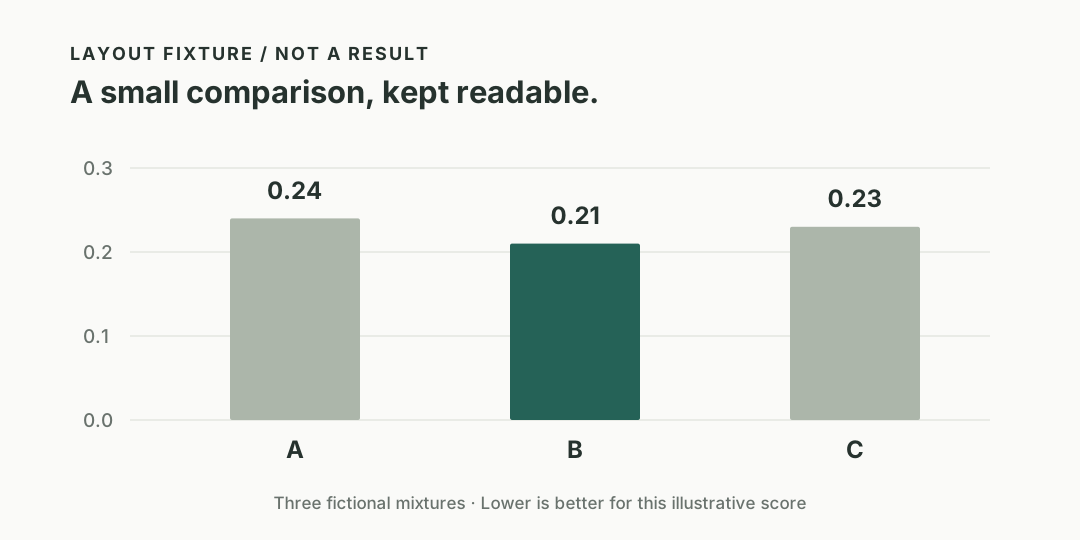
| A | 50% | 30% | 20% | 0.24 |
| B | 35% | 40% | 25% | 0.21 |
| C | 25% | 35% | 40% | 0.23 |
Lower is better for this fictional score. The difference is deliberately small; this page makes no claim that B is a better training recipe.
Preserve the trail
A minimal record can be plain JSON. It should be easy to copy, compare, and store alongside the code.
{
  "experiment": "layout-fixture",
  "synthetic": true,
  "seed": 42,
  "mixture": { "web": 0.35, "books": 0.40, "code": 0.25 },
  "toy_score": 0.21
}
The fixture above is intentionally small. More detail belongs in a repository when it helps reproduction, rather than in an increasingly long sidebar.
What this page is testing
Two levels of headings, inline and display math, a numeric table, a figure with a caption, a JSON block, a collapsible note, and footnotes. None of these values come from a real training run.
Leave the right question open
An attractive result is the start of an explanation, not a substitute for one. A full write-up would need the actual data, uncertainty estimates, repeated runs, and alternative explanations.
Here the useful next step is smaller: read this page on a phone, switch to dark mode, and make sure the equation and the table can scroll without moving the whole page. The interactive mixture checks the same quantities in a different form.
Footnotes
-
This footnote is a navigation fixture. Its return link should take you back to the reference in the paragraph. It contains no additional empirical result. ↩